
Our Approach
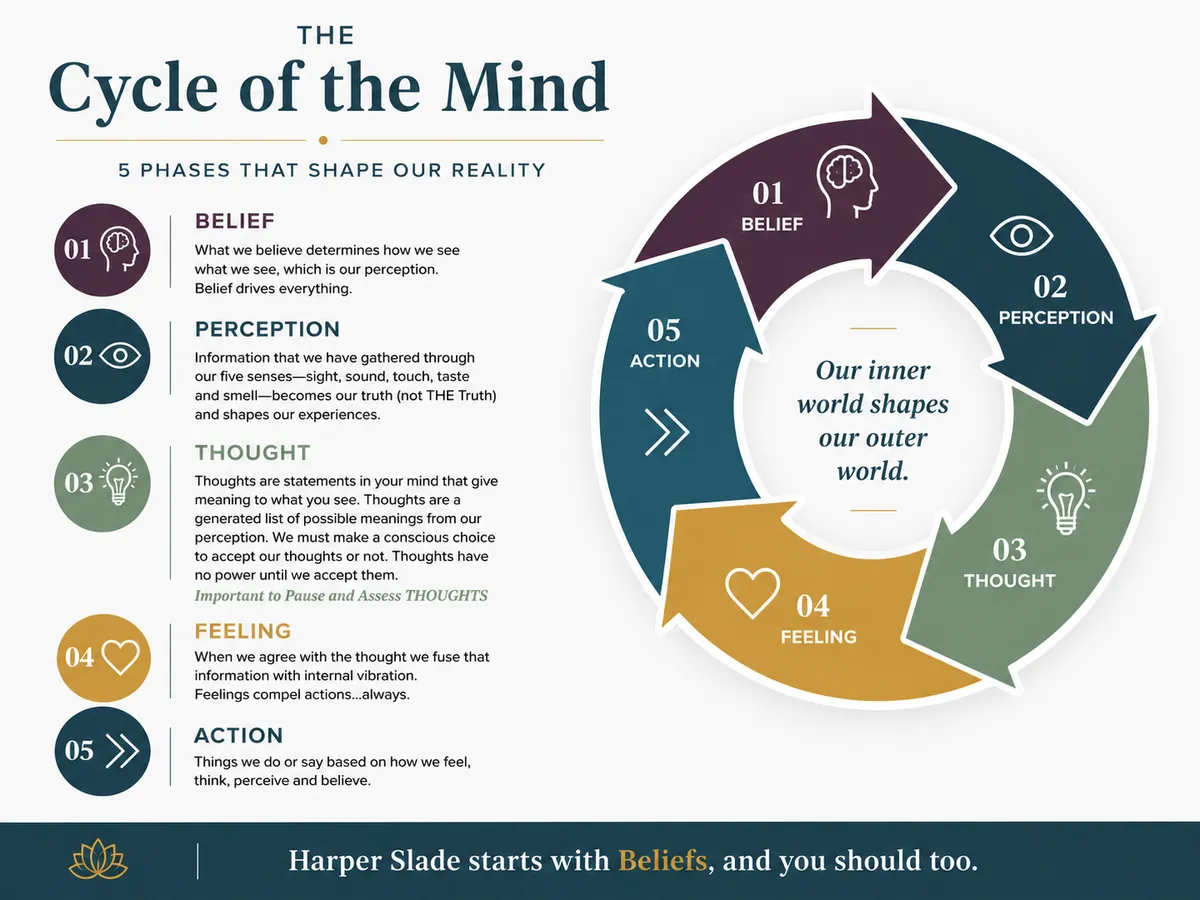
We start with what most people overlook: what we believe.
Harper Slade's work is grounded in two principles that shape every engagement—whether we are working with an organization, a city, a family, an educator, or women preparing to lead what comes next.
First, beliefs drive behavior. Second, all roads point to 2045.
Together, these principles shape how we understand people, systems, leadership, communities, and the future of the multicultural economy.
01 — Beliefs Over Behaviors
If we want to change what people do, we have to understand what they believe.
Much of the work designed to create more inclusive workplaces and communities begins with behavior: What should people say? How should they act? What policies should be written? What practices should be required?
Those questions matter. But they are not where Harper Slade begins.
We begin with the belief that beliefs drive behaviors.
The systems we inherited were not designed in a vacuum. They were shaped by the beliefs, assumptions, and worldviews of the people and institutions that built them—often without contemplating a multicultural society. Those beliefs can continue to influence how we see one another, how we interpret difference, how we make decisions, who we trust, whose potential we recognize, and what we consider normal.
If we only change behavior without examining the beliefs beneath it, we may change what is visible without changing what is producing it.
02 — All Roads Point to 2045
If we want to change what people do, we have to understand what they believe.
The United States is moving toward a fundamentally different demographic reality, with profound implications for workplaces, cities, communities, families, education, leadership, and the economy.
We call this horizon 2045—not simply as a date, but as a strategic reference point for understanding the America that is emerging.
The significance of 2045 is not only that the country is becoming more multicultural. It is that every system built around an earlier demographic reality must increasingly operate within a different one.
That creates both urgency and opportunity.
For organizations, it changes who is in the workforce, who leads, who buys, and what people expect from employers.
For cities and communities, it changes who lives, works, invests, participates, and determines what a successful region looks like.
For families and educators, it changes what children need to know and how they must learn to navigate a world defined by greater cultural complexity.
For women, it creates a moment of extraordinary possibility as women shape organizations, communities, families, and the future economy—and, in both literal and figurative ways, help birth what comes next.
2045 gives us a common destination from which to ask better questions today.
The Multicultural Maturity Framework™
A guidepost for moving from awareness to readiness.
Our Multicultural Maturity Framework™ provides the architecture through which we assess, diagnose, and design solutions for the clients and communities
we serve.
The framework recognizes that multicultural readiness is not a single initiative or a linear process. Different organizations, communities, families, and leaders enter the work from different starting points. Their needs, readiness, and opportunities are not identical.
Our five domains therefore serve as guideposts, not a checklist.
They may be engaged in different sequences, at different depths, and with different emphasis depending on the context. But they remain a consistent reference point in how Harper Slade understands readiness and designs meaningful change.
The Five Domains
Leadership Competency Integration
Building leaders who can understand difference, navigate complexity, challenge assumptions, and lead effectively across a changing landscape.
Structural Equity & Organizational Design
Examining the systems, structures, policies, and decision-making mechanisms that shape access, opportunity, experience, and outcomes.
Workforce Lifecycle & Talent Experience
Rethinking how people are attracted, developed, retained, advanced, engaged, and experienced across the full workforce lifecycle.
Learning, Development & Change Stewardship
Building the capacity to learn, adapt, and lead people through the transitions required by demographic, organizational, and societal change.
CEO/C-Suite
Belief Work
Creating the space for senior leaders to examine the assumptions and beliefs that shape strategy, culture, decisions, and the experiences of the people they lead.
These domains help us see both the human and systemic dimensions of change—because sustainable transformation requires attention to both.
An Approach That Travels Across Contexts
Our approach is intentionally designed to move across the four worlds in which Harper Slade works.
Organizations
We help leaders understand how beliefs, demographics, workforce expectations, and organizational systems intersect—and what that means for leadership, talent, culture, and competitiveness.
Cities & Municipalities
We help civic and economic leaders understand demographic change as an economic and leadership reality, building strategies that strengthen competitiveness, participation, trust, and regional resilience.
Educators & Families
We help the adults shaping the next generation develop the curiosity, empathy, cultural fluency, and the capacity that children will need to thrive in a multicultural world.
Community Advocacy
We create the community, leadership experiences, and strategic support that people need to navigate change, expand their influence, and help shape the organizations, families, communities, and economy that come next.
The context changes. The underlying approach does not.
What Makes Our Approach Different
We go beneath the surface.
We do not believe meaningful change happens simply because a new policy is written, a training is delivered, a strategy is published, or a conversation is convened.
Those things can be important. But sustainable change requires understanding the beliefs, systems, relationships, and demographic realities underneath them.
We work at the intersection of hearts, minds, systems, and the future. We ask:
What do we believe?
How do those beliefs shape what we see?
How does what we see influence how we think and feel?
How does that ultimately shape what we do?
And what does all of this mean in a world moving toward 2045?
Those questions create the foundation for the work we do across organizations, communities, families, and women's leadership.
The Future Requires More Than Better Behavior
The multicultural economy will not be built simply by asking people to behave differently.
It will be built by people and institutions willing to examine what they believe, understand the world that is emerging, and develop the maturity to navigate difference with greater intention.
That is the Harper Slade approach.
We help people understand themselves. We help leaders understand systems. We help communities understand demographic change. And we help all of them understand what 2045 requires of them.
Because the future we are preparing for is not simply more diverse.
It is fundamentally different—and Harper Slade exists to help people and institutions become ready for it.

Preparing the world for the multicultural inevitability and the economic opportunities that follow.
STAY CONNECTED


© 2026 Harper Slade Advisors, LLC. All rights reserved.
Privacy Policy
Terms of Use